3 November 2025 by Jeremy Maggs
JEREMY MAGGS: A warm welcome to Mandates & Megaphones. It’s in association with Standard Bank. Around the world, millions remain locked out of opportunity because education and employment systems are not keeping pace with technology, demographics or, I guess, the changing nature of work.
Now, the B20 Employment and Education Task Force, chaired by Sanlam group chief executive Paul Hanratty, has put forward a powerful agenda. It calls for nothing less than a new social contract between business, government and workers – one that links lifelong learning, digital inclusion and job creation in a fast-changing world. It’s big, it’s bold and ambitious. So let’s explore this in a little more detail.
Paul, a very warm welcome to you. Maybe let’s start with the big picture. Your taskforce identifies what you term full and meaningful employment as essential to social and political stability. What, in your and the group’s opinion, makes this particular moment so urgent?
PAUL HANRATTY: Jeremy, thanks very much for talking to me. I think we’re at a hell of a juncture in the world. There’s dislocation, as you can see, and I suppose the whole tariff situation has highlighted that.
But if you go beyond that, we’re really on the edge of perhaps one of the biggest technological revolutions of all of our lifetimes – and perhaps of all history – in the form of AI.
On the back of the Covid pandemic, you’ve also got, even in developed countries, very high levels of youth unemployment and, in fact, disengagement.
It stands to reason that if you exclude huge proportions of the population from economic life, you’re going to have political instability.
That’s not good for any of us. It’s not good for business, which, of course, is our agenda, but it’s not good for politicians and society at large.
I’m certainly a firm believer that we all need a purpose in life, and that meaningful employment is quite central to that.
I think we’ve all collectively, in the world, got a big and building problem on our hands that we need to deal with.
JEREMY MAGGS: Is there a danger, Paul, that we might have left this, or are leaving it, too late?
PAUL HANRATTY: Well, there’s always a danger of that, and humans are great at leaving things too late. I think by nature we tend to be a bit short-term. We only deal with things when there’s a burning platform. But of course, you have to believe that nothing’s ever too late to deal with, and I don’t think it is too late. But I do think we need to get on with things.
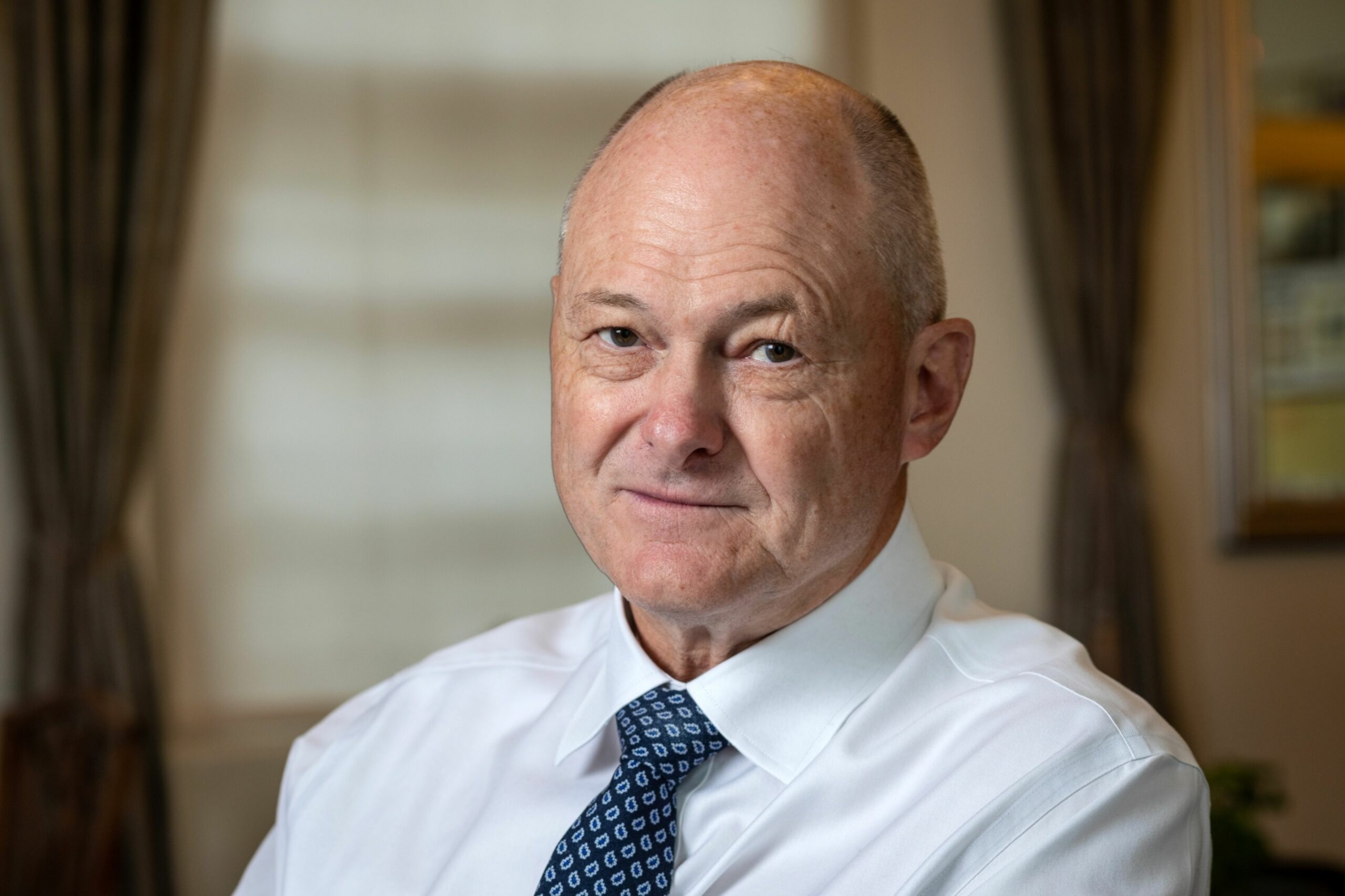
Paul Hanratty, CEO of Sanlam and chair of the B20 Employment and Education Task Force. Image: Dwayne Senior/Bloomberg
JEREMY MAGGS: Getting on with things means recalibrating, I imagine, the entire education system, and that has to adapt to the demands of the digital economy, as you pointed out in your first answer. Where’s the starting point, Paul?
PAUL HANRATTY: It’s very interesting. We think the starting point is actually early childhood development. Let me start by saying I’m a finance person. I know very little, actually, about education, and I know very little about the economics of employment other than some common sense and how we see it from a business point of view.
But it seems really apparent and somewhat obvious that if you don’t get the basic building blocks in place in early childhood, it’s a battle from then on.
So we all read tons about people going to university and how important this is, and so on. But actually, if you haven’t built the base at the very beginning, the rest is not going to happen.
If you think of 100 kids, if 80 of them don’t have a proper start in early childhood, there are only 20 with any chance of getting to university is the reality. We need to start very early on. We thought that was a particularly African and emerging-market issue, but it turns out that’s a big issue everywhere. Actually, even in developed countries, early childhood development is often neglected.
So that is actually the starting point to things. The other thing, if you think of how our economies have evolved over time, education has evolved a lot less.
Schools are not that different today to how they were a couple of hundred years ago, which is kind of madness, isn’t it, if you think about it?
We think that the pace of change is such that you can no longer have the notion that we all get some early education and then we’re off and working. Actually, all of us have to continue to sharpen and learn. I always say to people, I think I learn something new every day, and we have to have that mindset.
So right from the beginning we’re going to have to do things differently. But then, all the way through our lives, we’ve got to actually function differently and keep re-equipping people.
The thing I’ve always marvelled at about the US economy is how quickly it responds. When there are recessions, employment dips very quickly but they come back. They’re very agile at coming back and of course, there are a whole variety of reasons for that.
If you contrast it to Europe, which takes a lot longer, you can look at all sorts of legal and labour law issues and so on but basically, that ability to recover quickly means that you’re able to shift your skills to different places. But now we’re going to live in a world where I think we’re going to need that even faster.
If we’re not prepared to collectively invest in lifelong learning, it’s going to be a problem.
JEREMY MAGGS: I want to talk about shifting skills, and particularly as far as the continent of Africa is concerned, in just a moment. But Paul, let me take you back to early childhood development, which I think is critical. How do you change or convince business not to ignore that base? All too often, business is focused on the here and now, the important needs that will serve its purpose and profitability. In other words, bursaries, technical education, financial education at a tertiary level. It’s a difficult case, surely, to say to business, well, we’ve got to refocus our attention elsewhere.
PAUL HANRATTY: Jeremy, let me start by saying unequivocally, you will never get business to focus on things where they can’t see a relatively quick return.
We’re not saying that business should focus on early childhood development. The point of the B20 is to look and say, from a business point of view, what do we need, and then we try and encourage government institutions to focus on it.
I think early childhood, as much as I might be a capitalist and a free-marketeer, it’s certain in my mind that there are lots of things that the state and the public sector need to do.
Early childhood development is really, I think, a massive responsibility for the whole of society. I’m not saying business should have nothing to do with it, but I think this thing starts with government.
Part of it starts with policy and regulation, and it’s just a neglected area. We get off on a bad foot, and you can’t get on the front foot when you start on the back foot. So we are really encouraging governments to pay much more attention to getting our kids a good start in life.
JEREMY MAGGS: On a broader canvas, Paul, many of the recommendations actually do rely on government coordination. They talk about joint meetings of finance and employment ministers, for example. But how confident are you that the political will exists to make that happen? Because if that happens, it addresses all the other issues that you’ve put on the table, surely.
PAUL HANRATTY: One of the challenges of this process is just how you get things done.
I say to people, when we as South Africans – I was talking to Cas Coovadia [CEO of Business Unity South Africa] the other day – when we as South Africans got given this B20, none of us had ever had any experience of it before. So in a sense, you’re catching a moving train.
What’s become very apparent to me, though, is that you are a little step in the history of this thing, and it goes from one year to the next.
So what you try to do is pick up and not come up with completely new things from the previous B20, you try and build, and you try and come up with things that are fairly well aligned to what the G20, the governments, are actually thinking.
Because if you come up with things that are 180 degrees polar to them, there may be no chance of success.
So there is some pragmatism required. What you hope is that what you put together will also be taken on and the baton carried forward into the following year.
I can tell you it’s not easy, because among the G20, and B20, there are very, very different agendas. We had people from Latin America, from the US, from Europe, from Asia, China and so on.
The views and the lenses that people look through are very, very different. So it’s a massive challenge. But I think that if one can keep pushing on some of these things, you hope that eventually the message gets through.
So this is the collective voice of business across the world, talking to the collective voice of government, an ongoing dialogue over many years, and I guess the measure of success is: can you make a difference?
Not in your one year of having it, but on the bigger canvas.
I think if you really say, what difference will South Africa and Africa have made in this one year, it’s quite hard to be sure that you’re going to make a very specific difference. You’re really trying to keep the momentum in the train, and you hope that eventually some of these things sink in.
Some of the things I was talking about, the politicians, and governments, must be feeling these forces as well. I was looking at this morning’s business paper from the UK, even if you categorised it, 80% to 90% of the stories are about doom and destruction in the economy. So the politicians can’t be fast asleep and ignoring all of that, they just can’t.
JEREMY MAGGS: Thank you very much for a very frank and honest answer there. Because that interlock, as you talk about, between B20 and G20 is difficult. It’s going to require a lot of compromise, because if you don’t find that acceptable compromise, it’s going to lead to inertia and just a waste of time.
So let me ask you frankly, do you think that you’ve put enough on the table to reach the kind of consensus that you’re hoping to achieve?
PAUL HANRATTY: Yes, I do. I think we’ve got some really great things on the table, and I think there are some quite controversial things.
I think a lot of what we’ve said, most people with common sense would agree, are okay, but I’ll pick out one area which I think is super interesting.
I don’t think it’s going to get unanimous support, even within our team it did not have unanimous support, but it’s something that will stimulate debate – and that’s the whole area of platform economies and tech platforms.
This is relatively new in economic terms, and you find, particularly in many parts of the developed world, governments trying to force regulation into that space that comes from an era of the industrial age, factories and perhaps offices at best. We really took the view that that is going to kill job creation and growth and innovation.
You can imagine, on a spectrum, if you go from west to east, how different countries think about that. The US is obviously very keen on being heavily deregulated, but there are very strong voices to clamp down on that. We’ve come out and recommended very strongly that we don’t kill that, let’s be very careful about over-regulating it.
But that’s going to be a big debate that gets stimulated, and that debate is not going to go away. That debate is going to be going on for the next few years as people grapple with … there are positives, but as you know very well, there are lots of potential downside risks from things like AI that have to be managed as well.
We’ve pushed quite hard on the deregulation and keeping it free and open.
But of course, one has to think about the negatives and how you’re going to limit and control those, because completely unfettered, there’ll be some problems.
JEREMY MAGGS: So how would you find a useful short-term compromise to appease all parties in that respect then?
PAUL HANRATTY: Look, we didn’t, we actually just pushed quite hard because we knew that there would be a natural resistance. So we’ve pushed quite hard for it to be fully unregulated, knowing that the reality is there’ll be a counterbalance to that. We’ve not tried to find a compromise on that one.
JEREMY MAGGS: Let me pivot, your report, and you’ll correct me if I’ve got the number wrong here, but it suggests that G20 countries invest 0.5% of GDP in lifelong learning. Paul Hanratty, that’s very ambitious. Is that investment non-negotiable?
PAUL HANRATTY: Well, Jeremy, the one thing about every budget, and I guess it applies even to most home budgets as well, is that there’s never enough money for everything, is there? So it’s a question of prioritisation.
You come back to, I think [the fact that] the great economies of the world invest; the poor economies of the world spend.
What we’re talking about here is an investment in human capital.
We’re saying to countries, you’d better think very hard about this thing, because if you just spend and spend and spend and you’re not investing in human capital, with the pace of change, you’re going to have a problem because you’re going to have unemployable people.
So we do think that it’s a benchmark that countries should start thinking about, are they spending on training and development and reskilling at an appropriate level? I think if you went and looked at what the actual number is, it’ll be minuscule compared to 0.5%.
So it’s very, very ambitious. But if you don’t put something out like that, then you’re not going to get anybody’s attention.
But would our government, for example, find that within the budget next year? Very unlikely.
But look at the debate on defence spending in Nato [North Atlantic Treaty Organisation], that’s a good example. That’s plummeted over the years, and you can see the consequences of it. So later on, there has to be an adjustment, a very painful adjustment.
So we do think that there needs to be some thought from government about this topic.
JEREMY MAGGS: Let’s come back to the shifting skills argument that you put forward a little earlier, because the investment does relate to the next question. If you look at Africa specifically, what was on the table that you believe needs to happen to ensure that young people are not left behind? As you also said earlier, as artificial intelligence transforms the workplace almost on a day-to-day basis.
PAUL HANRATTY: Jeremy, I think if you talk about Africa, it’s pretty scary because forget AI, we start with a big problem to begin with, and AI can only make that worse.
I think Africa is going to have to think very, very hard about how we adopt AI, because we don’t want to make an existing problem worse.
But the thing that we maybe haven’t spoken about yet is one side of things is this high-tech move to digital and so on. Of course, for people who work in the finance sector, that’s very apparent to us.
But I’m of the school that we still have lots and lots and lots of what I would call proper jobs that can’t be replaced by AI.
I think this continent is bereft of infrastructure. So that is a huge area that governments need to focus on because we need infrastructure, and that in itself will create lots of jobs.
We don’t need very advanced tech skills to do that.
Then the other thing we need to do is we really need to unlock in Africa, but even more so in South Africa, the SME [small and medium-sized enterprise] sector. South Africa has a very, very poor informal sector and this is an area that really needs to get urgent attention from policymakers.
It’s not about high tech; it’s simply about creating the conditions for it to be possible for people to utilise their God-given talent and create economic opportunities for themselves.
To put it into context, in South Africa, of the employable population, 50% are in the formal sector, but we only have 17% in the informal sector. Now, the benchmark for a country like us is 45% in the formal sector and 45% in the informal sector, but we’ve only got 17%. There are a whole variety of reasons for that very poor performance of the informal sector, but we really need to get that right, because the secret to job creation lies in the SME sector. It doesn’t lie with big business and manufacturing and so on. It really does lie in unlocking that.
South Africa has to find the key to that door. It’s been researched very heavily by some of the best academics in the world, and we know what the issues are.
We also know what some of the solutions are, and that requires quite a big policy shift, actually, from government but not just from central government, from local government. The regulation that is applied is very prohibitive to anybody wanting to be in informal employment.
JEREMY MAGGS: That’s exactly the point. You talk about the key, Paul, and we know what the key is, we hold it, it’s about removing regulatory red tape for SMEs. In that respect then, again, on a broader canvas, where do you see the quickest wins if the G20 acts on this?
PAUL HANRATTY: Some of the things are spread across the whole G20.
I personally think for the G20 as a whole, the quickest wins are probably in the platform economy.
But if you talk about Africa and South Africa, I think our quick wins are probably in the SME space, unlocking that, because I think it’s relatively easy to do with the right will.
I’m a massive believer in Adam Smith’s invisible hand [theory], which actually basically means that humans are talented and smart and find ways to do things, and they’ve got a basic spirit in them.
So you don’t need to centrally plan things, you need to actually enable people. Then they’ll get on and solve the problem, because only millions of individuals can solve the problem, not a few people at the centre.
JEREMY MAGGS: Paul, the taskforce calls for a new Youth Employment Compact, if I’ve read this correctly. What does that look like in real terms for a young jobseeker, not only in South Africa, but maybe in India or even Brazil?
PAUL HANRATTY: What we were looking for in our task force were examples of things that had been done that could be put forward almost as case studies for people to learn from.
I think actually, this is something that in South Africa we have an absolutely world-class example of.
We’ve built Harambee [Youth Employment Accelerator], and the Yes [Youth Employment Service] programme has built a platform called SAYouth.mobi and any young person can go on there and look for jobs, and any employer, whether you’re a big corporate or an SME, can also go and post and find people on there.
We’ve created a fantastic technology platform to connect young people to job opportunities. We think that that bit of tech is something that could be copied and replicated very easily in other countries because, I don’t know on a scale, but South Africa wouldn’t be the best in terms of mobile connectivity and so on.
So if we’re able to do it, certainly almost every country on earth could do it.
Then if you add to that, if we can start moving our skilling of young people to be much more in line with the needs of the economy, so we need to sort that out that aspect. If we start giving the right skills, and we start connecting youth to the employment opportunities using technology, there’s a lot that can happen in that space.
JEREMY MAGGS: As you chaired this – and we’re coming to the end of this conversation – as you chaired this all-important task team, did you get a sense of desperation or a sense of real optimism? I know you said to me at the start of our conversation, you’re an optimistic guy, but you’ve thrown big things on the table here. You must have looked at this at times and said to yourselves: ‘Jeez, how do we even make a start here? How do we chip away here?’
PAUL HANRATTY: I think the sort of people who you have on a task force are, by definition, I guess, optimists. For example, one of the people we had was the founder of LinkedIn. You can imagine someone like that is going to have a very positive view on what’s possible.
Actually, Jeremy, most of us have children, maybe even grandchildren in some cases, so no matter how difficult a task or problem is, actually we need to solve the problem.
Because it’s not about this generation necessarily. You and I, with respect, we’re at the stage in our lives where we’re okay, we don’t have to worry about the future of work and so on. But I think it’s a really profound thing, and we owe it to our children and our children’s children to apply our minds to these things.
I think people, yes, they are optimistic, and I’m optimistic. The reason for that is, again, humans are capable of solving any problem, no matter how difficult it is.
But in order to do that, it does require collaboration, and it requires us to be open-minded. I think open-minded means that we can put our own opinions out there, but you also need to listen very carefully to other people because things are changing, and you need to adapt.
I think as a society, we all need to collaborate and listen to each other and realise that we’ve got a building problem.
I looked a few days ago, in a place like Britain, 15% of young people are neither in employment nor in education. They’ve dropped out. That’s one in six. Do you think you can build a society on that? I don’t think so.
JEREMY MAGGS: So let me, in conclusion, then circle right back to something you said to me when you said ‘I’m a finance guy’. If you’re talking about this debt that we’ve got to our children and grandchildren, Paul, let’s talk about measurement very quickly. How will we know if any of this is working – all that stuff that you put into the report and the outcomes that will show that the G20 has moved from dialogue to some form of delivery, albeit maybe small and incremental?
PAUL HANRATTY: Ja, I think in the short term, what we can do is measure whether some of the actions have been implemented.
I think that’s fairly easy to see and to measure and to get going. In the longer term, I think what one has to look at is how many new jobs are getting created, how many of those jobs are actually getting filled, and how many are not getting filled because the skills don’t exist. So I think it’s quite possible to measure it.
I think, again, you come back to this issue of finance ministers and employment and education ministers. The finance guys will be a bit like some of us, we want to measure the profits and so on. But actually, the truth is we don’t measure profits as much as we measure lots of lead indicators.
What we need our finance ministers around the world to do is to start measuring lead indicators – what’s going to drive your GDP growth in five and 10 years’ time?
Well, you’d better start actually paying attention to those, not just to this year’s budget and this year’s fiscal deficit and so on. Because if you’re not applying yourself to those longer-term growth drivers, everybody knows what they are, so we’ve got to get those KPIs [key performance indicators] up.
I believe finance ministers and treasury functions in countries have got to pay attention to them and make sure that we are investing in the future, that we are investing in the youth, that we’re making sure we are creating jobs, and that the right skills are being put in place, because those are the lead indicators of the future.
It’s always a balance between, yes, we have to balance the books today, but if we don’t pay attention, just like in business, if we just focus on this year’s profits, it’s only a matter of time before your business falls off a cliff.
You have to pay more attention in reality to the future than you do to the current period. People in leadership – leadership is actually about looking forward; it’s not just about addressing the problem under your nose today.
JEREMY MAGGS: I think that’s a good place to put a punctuation point. I’ve been in conversation with Paul Hanratty, chair of the B20 Employment and Education Task Force, also group chief executive officer of Sanlam.
Very quickly, what’s clear to me is that this agenda is not about abstract goals, as we’ve been discussing. It’s about rethinking how societies prepare people for work in this age of automation and inequality.
The call to action is direct: align finance with education, match skills to opportunity, and make growth inclusive by design.
So that’s it for this episode of Mandates & Megaphones here on Moneyweb, brought to you by Standard Bank.
The Mandates & Megaphones podcast is being published weekly on Mondays until the summit concludes in late November. Listen on Spotify, iTunes, and other popular platforms or download the Moneyweb app to stay informed – anytime, anywhere.
Click here to view the source.