As with the 2024 Draft Sector Targets, the 2025 Draft Sector Targets are set for “designated groups”, broken down by gender, but there are no specific targets per racial group. The figures are, however, markedly different from the 2023 and 2024 Draft Sector Targets and in many instances are significantly increased.
South Africa is considered to have some of the longest working hours in the world, but to change this would require massive increases in wages and changes to the country’s labour laws.
The Nedlac Report on the Labour Law Reform Process has now been published, following negotiations on substantive labour law reforms between organised business, organised labour and government at the National Economic Development and Labour Council (Nedlac), which commenced in April 2022.
The Department of Labour and Employment (DoL) will finalise consultations over South Africa’s new BEE targets by the end of February 2025 and publish two new employment equity regulations by the end of March.
On 17 February 2025, the Department of Employment and Labour (“DoEL“), held a virtual meeting where various stakeholders and industry players met to discuss and engage on, inter alia, the employment equity sector targets for the Professional, Scientific and Technical Sector.
During December 2024, the Department of Employment and Labour (DoEL) sent invitations to various stakeholders within 18 sectors, inviting them to attend virtual consultation meetings on numerical sector targets.
The hotly debated Companies Amendment Bills have now been signed into law by the President and were promulgated on 30 July 2024, with the date of implementation yet to be announced.
A new report by the Centre for Development and Enterprise (CDE) calls for a radically new approach to small business development. “Given the stagnation of the small business sector and a government riddled with deficiencies and inefficiencies, the time has come to hand the reins to the private sector and let markets shape the future of entrepreneurship in South Africa,” said Ann Bernstein, executive director of CDE.
The Minister of Employment and Labour, Ms. Nomakhosazana Meth, has announced an increase in the National Minimum Wage (NMW) for the year 2025, raising it from R27.58 to R28.79 per ordinary hour worked. This adjustment marks a 4.2 percent increase and is aimed at enhancing the economic stability of workers in South Africa.
JOHANNESBURG – A Draft Code of Good Practice on Dismissal is set to have an impact on Employment and termination procedures in South Africa. The new code has been published by the Employment and Labour Department and is open to public comment.
The newly published Draft Code of Good Practice on Dismissal marks a pivotal reform in South Africa’s employment dismissal framework, providing employers with clearer guidelines, enhanced flexibility, and a strong focus on fair labour practice.
With Sakeliga’s launch of a critical legal challenge to reverse harmful state overreach and BEE in the property sector, its CEO Piet Le Roux warns that the business interest group will have “more and more concurrent cases on these critical matters, not only on BEE in the property sector, but BEE in competition law, BEE in health products” – and is building “a wonderful case” against the NHI.
An employee’s Labour Court bid has failed after he was dismissed from his job at Overberg Agri-Bedrywe due to using his cellphone while operating heavy machinery, which breached the company’s safety policies.
Sending certain WhatsApp messages can land you in trouble with your employer or in jail in South Africa, and Legal Leaders managing director Aslam Moolla says South Africans should also be careful about sending emojis in work-related conversations.
In a retrenchment process, a section 189(3) notice is often regarded as the vital first step. It serves as an invitation to consult on proposed retrenchments and provides the consulting parties with all relevant information including, among other things, the reasons for the proposed retrenchments, alternatives to retrenchment that have been considered, the proposed selection criteria, severance pay and timing of dismissals. Usually, these topics form the agenda at the consultation meetings.
In a retrenchment process, a section 189(3) notice is often regarded as the vital first step. It serves as an invitation to consult on proposed retrenchments and provides the consulting parties with all relevant information including, among other things, the reasons for the proposed retrenchments, alternatives to retrenchment that have been considered, the proposed selection criteria, severance pay and timing of dismissals. Usually, these topics form the agenda at the consultation meetings.
Misclassifying workers as independent contractors instead of employees can expose employers to serious risks, both from a labour law and tax perspective. The Labour Relations Act 66 of 1995 as amended (“LRA”) and other relevant labour laws provide essential protections to employees that independent contractors do not enjoy. Additionally, tax responsibilities shift significantly when someone is deemed an employee, as employers have obligations to the South African Revenue Service (“SARS”) in this context.
The Employment Equity Amendment Act (EEA) 4 of 2022 came into effect on 1 January 2025 and is all about promoting diversity and equality in the workplace.
Business groups are preparing a legal fightback against South Africa’s new Employment Equity Amendment Act (EEAA), which will come into effect on 1 January 2025.
As we approach 2025, it’s crucial for employers across South Africa to start gearing up for significant changes under the Employment Equity Amendment Act 4 of 2022.
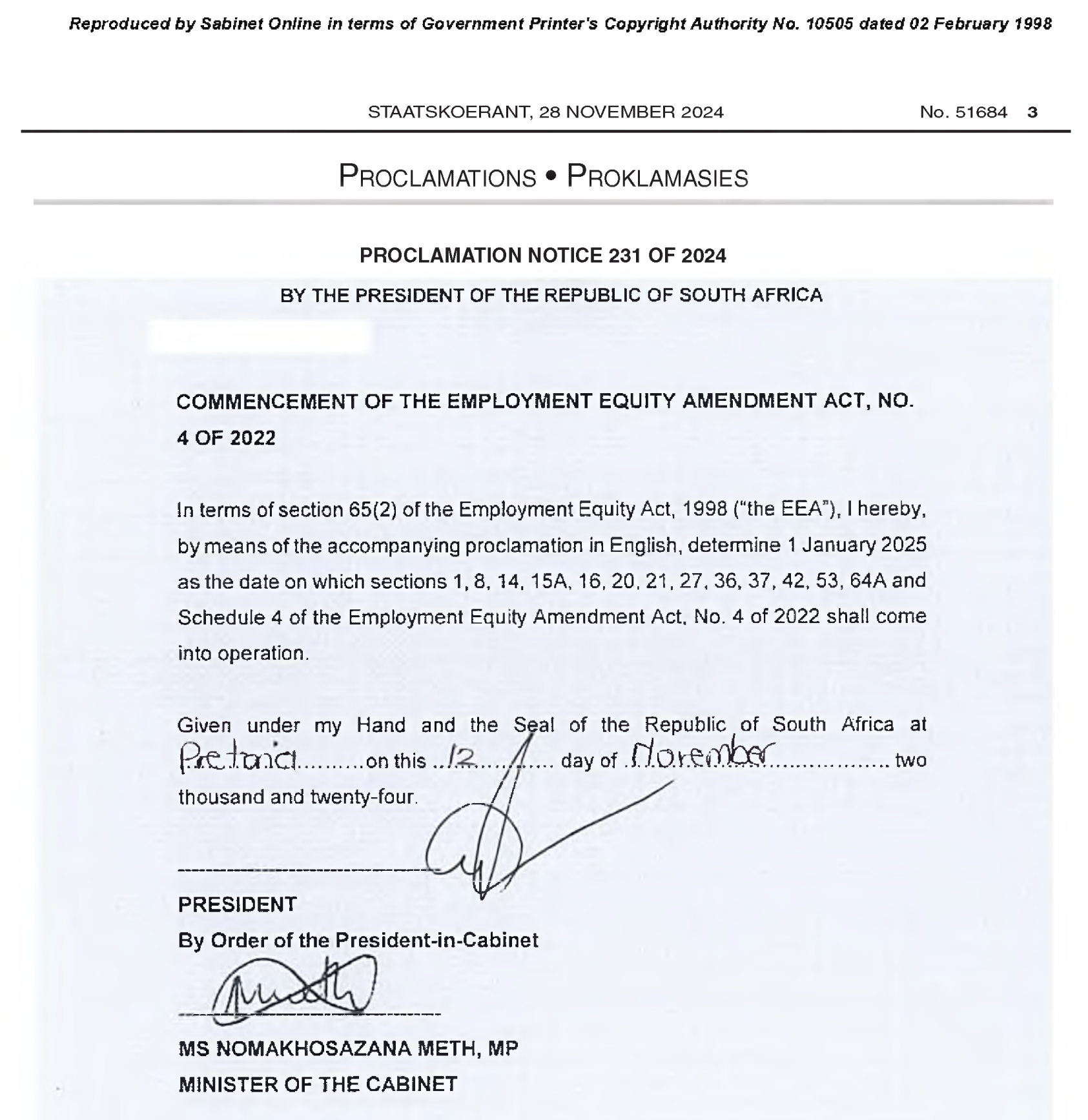
The President of the Republic of South Africa has recently proclaimed that the Employment Equity Amendment Act No.4 of 2022 (EEAA) shall come into operation on 1 January 2025.
There is mounting foreign case law providing both employers and artificial intelligence (AI) developers with food for thought as South Africa ushered in the National Artificial Intelligence Policy Framework 2024 (Policy Framework) in October 2024.
Department inspectors visiting homes in Secunda between November 4 and November 29, will be able to help with the relevant documents and forms and to offer advice how an employer can be compliant with labour legislation.
In any employment relationship, formal documentation of agreements and policies plays a critical role in creating a structured and legally compliant organisation. Every organisation is obligated to implement a comprehensive set of policies and procedures to ensure full compliance with regulatory standards.
Meeting with the Institute of Race Relations (IRR) this week, the SAHRC maintained that racial categories form the basis of implementing policies aimed at redress.
Unlike the first corporate-made black billionaires – including President Cyril Ramaphosa – those excluded from the creation of a black bourgeoisie and the corporate takeover of selected ANC leaders were left to fend for themselves, and illicitly helped themselves to any available source of wealth.